
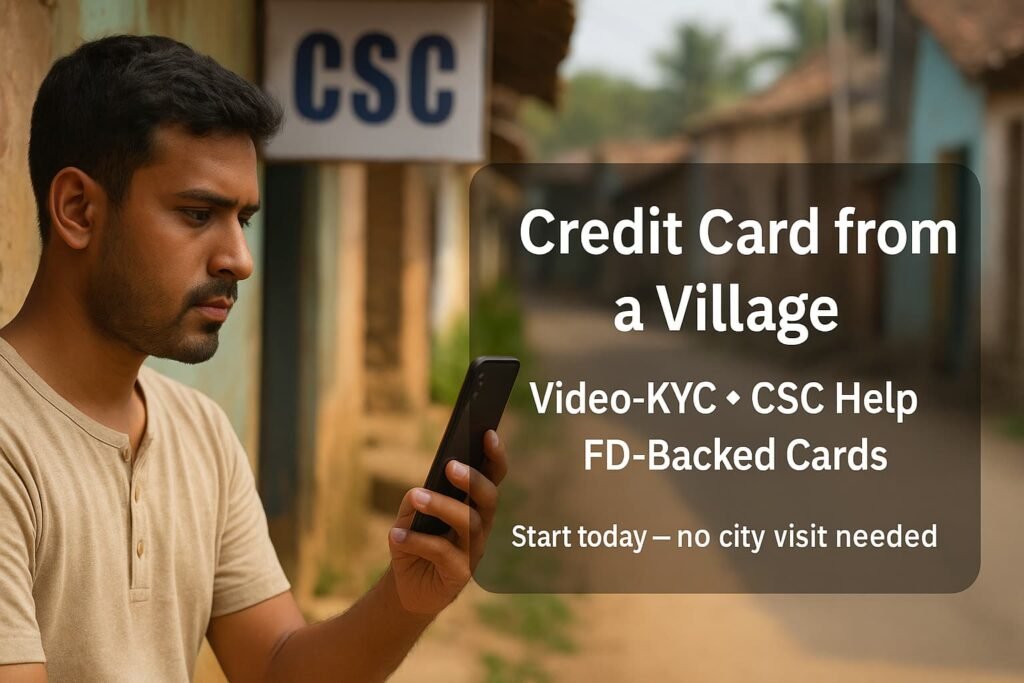
Credit Card from a Village is no longer a city-only dream. In many parts of rural India, cash still rules daily life, shops may not accept cards, and thin or zero credit histories make approvals feel out of reach. That’s changing fast. With Video-KYC, help from local Common Service Centres (CSCs)/Banking Correspondents, and FD-backed (secured) cards, you can apply from home—even if your PIN code is far from a big branch. This step-by-step guide shows the simplest routes, the documents you’ll need, and the safety checks to avoid scams, so you can move from cash-only to safer, flexible digital payments, start building a credit profile, and take practical control of your financial future.
Steps to Take a Credit Card (village-applicant routes)
Visiting a branch (nearby taluk/district town)
What it is: in-person application when online steps are hard. Carry PAN, Aadhaar, one address proof (passbook/bank statement is fine), and income proof if available. Ask if your village PIN is serviceable; if not, request branch pickup or give a deliverable town address you can prove. Submit the form, set full-bill autopay before you leave, and track status by SMS.
Official website (from your village)
What it is: apply on the bank’s site using Video-KYC to avoid travel. Fill the form during a stable-network window (early morning/evening), note the reference number, and complete the video call at home or at a CSC if signal is weak. Update Aadhaar address first to reduce rejection. If courier can’t reach your PIN, choose branch pickup or a provable alternate address.
Mobile banking app (existing customer)
What it is: fastest for villagers who already have a savings account with that bank. Check “Pre-approved/Offers”; you may get an instant virtual card, with the physical card sent to a serviceable address. If data is patchy, finish e-mandate/autopay when you’re in town or on CSC Wi-Fi, then enable alerts and set spend limits.
CSC/Banking Correspondent (assisted)
What it is: apply with help at a Common Service Centre/Bank Mitra when you lack a smartphone, scanner, or steady internet. The VLE scans PAN/Aadhaar, fills the form correctly, and schedules Video-KYC on a stable connection. Pay only the posted service fee and take a receipt. Track by SMS, and opt for branch pickup if your PIN isn’t serviceable.
FD-backed (secured) card via reachable branch/app
What it is: place a Fixed Deposit as security to get approved when you’re new to credit or delivery is tricky. Open the FD (often 12-month tenure), apply for the card against it, and expect a limit around 75–90% of the deposit. Keep usage under 30%, turn on full-bill autopay, and after 6–12 months request an upgrade and lien release.
Key Documents Required by Application Type
To avoid repeat attempts and delays, keep these documents ready before you apply—whether you use Video-KYC from home, get help at a CSC, or choose an FD-backed card. This layout shows a table on desktop and simple cards on mobile.
| Document Type | Video-KYC Application | CSC-Assisted Application | FD-Backed Card Application |
|---|---|---|---|
| Identity Proof | Original Aadhaar & PAN shown on camera. | Aadhaar, PAN photocopies + originals for verification. | Aadhaar & PAN as per KYC norms. |
| Address Proof | Aadhaar with current address, or accepted alternative if recently updated. | Aadhaar, Ration Card, or recent Utility Bill (as accepted by bank). | Aadhaar with current address, or recent Utility Bill/Bank Statement. |
| Income Proof | Often not required for entry-level cards (varies by bank/product). | Not required for secured cards; may be asked for unsecured cards. | Not required (FD serves as security). |
| Other Proof | Clear photo, live signature, and your application/reference number. | Two passport photos, CSC receipt, and application/reference number. | Fixed Deposit details (FD number/acknowledgement) for lien marking. |
Identity Proof
Address Proof
Income Proof
Other Proof
Note: Exact requirements vary by bank and product. If your Aadhaar address is outdated, update it first or carry an accepted alternate proof (recent bank statement/passbook or utility bill). Keep your Aadhaar-linked phone handy for OTPs.
Challenges in Village Areas
Rural applicants often face practical hurdles—patchy network, non-serviceable PINs, address/document gaps, or thin credit history. Here are the most common challenges and **quick fixes**.
Poor network
Fix: Video-KYC drops or blurs ID—try off-peak hours, move near a window, or complete it at a CSC/BC with better internet.
PIN not serviceable
Fix: If courier can’t deliver, opt for nearest-branch pickup or use a deliverable address you can prove (relative’s town address + bill/statement).
Address proof mismatch
Fix: Aadhaar outdated or bills in another name—update Aadhaar or carry accepted alternatives (bank statement/passbook).
No/low credit history
Fix: Higher rejection risk—begin with an FD-backed (secured) card to build score for 6–12 months, then upgrade.
Irregular income docs
Fix: Route earnings via one primary savings account and keep a small RD for stability before applying.
Digital / language gaps
Fix: Forms and calls feel tricky—take help at a CSC/BC and request regional-language support.
Unclear address / landmark
Fix: Add precise directions/nearby POI and keep your phone reachable on delivery day.
Hidden fees / mis-selling
Fix: “Lifetime free” may have conditions—read the fee sheet (MITC) and apply only on official bank sites/apps.
Scam calls / messages
Fix: Requests for OTP/CVV/PIN are fraud—never share; enable SMS/app alerts and block the card at first suspicion.
Autopay failures
Fix: Low balance causes late fees—set full-bill autopay with a small buffer and verify the debit each month.
How to Overcome These Challenges
Simple, practical fixes you can use from your village—choose the one that matches your situation.
Poor network
Book Video-KYC in off-peak hours, stand near a window, lock phone to 4G/5G; if calls still drop, complete it at a CSC/BC.
PIN not serviceable
Check serviceability first; ask for branch pickup or use a deliverable address you can prove. Start FD-backed and update address later.
Address mismatch
Update Aadhaar before applying; keep an alternate proof ready (bank statement/passbook or recent utility bill).
No/low credit history
Begin with an FD-backed card, enable autopay (full), keep usage <30%; request an upgrade after 6–12 months.
Irregular income proofs
Route earnings through one savings account for 2–3 months; keep statements and add a small RD for stability.
Digital/language gaps
Take help at a CSC/BC, request regional-language support, and rehearse showing PAN/Aadhaar on camera.
Delivery confusion
Add a clear landmark/POI and phone number in address notes; keep your phone reachable on delivery day.
Hidden fees / mis-selling
Read the MITC; confirm joining/annual fee, APR, cash-advance and forex markup; apply only on official sites/apps.
Scam attempts
Never share OTP/CVV/PIN or screen-share; enable SMS/app alerts and block the card at the first suspicious charge.
Autopay issues
Set full-bill e-NACH, keep a small balance buffer, and verify the debit 2–3 days before the due date.
The Modern Approach — Video-KYC & Digital Applications
What is Video-KYC?
A secure video call with a bank officer to verify your identity in real time. You can do it at home on a smartphone with data—many big banks support it, which makes a Credit Card from a Village possible without visiting a branch.
How it works (quick steps)
- Prepare: Keep PAN and Aadhaar ready; sit in a quiet, well-lit spot; test camera and data.
- Apply online: Use the bank’s official site/app; choose a card that mentions Video-KYC; fill details truthfully.
- Video call: The officer checks PAN/Aadhaar and does a liveness test (turn head/read digits).
- Delivery: If your PIN is serviceable, the card is couriered; otherwise request branch pickup or use a deliverable address with proof.
- Activate: Set PIN via app/IVR/ATM; enable only the channels you need (online/contactless/international).
Practical tips for villages
- Network: Try early morning/evening; stand near a window/open area.
- Lighting: Avoid backlight/glare; hold your ID steady and fully in frame.
- Data match: Ensure Aadhaar address matches your application (update first if needed).
- If the call drops: Rebook—weak-signal failures are common.
1-minute checklist
Common rejection fixes
- Blurry ID: Move to soft light; remove plastic sleeves.
- Name/address mismatch: Update Aadhaar or provide valid address proof.
- Frequent drops: Try from a CSC/BC or a stronger-signal location.
- Wrong site/app: Apply only via the bank’s official website/app—avoid agent links.
Video-KYC Checklist
Before you start the video call, run through this quick checklist to avoid failed KYC and repeat sessions.
| Requirement | What You Need | Why It’s Important |
|---|---|---|
| Identity Proof | Original PAN Card & Aadhaar Card | Needed to verify identity as per bank and government rules. |
| Location | A quiet, well-lit place with a plain background | Ensures your face and documents are clearly visible on camera. |
| Technology | Smartphone with working camera and microphone | Required for the video call—test both before starting. |
| Connectivity | Stable internet (Wi-Fi or mobile data) | Prevents call drops that force you to restart the process. |
| Application Details | Your credit card application/reference number | Lets the officer quickly pull up your file. |
| Availability | Time to complete the call in one sitting | It’s a one-time verification; uninterrupted time helps finish smoothly. |
The Physical Bridge — Using Common Service Centres (CSCs)
What is a CSC?
A CSC is your village’s digital help desk, run by a Village Level Entrepreneur (VLE). It gives access to government portals and basic financial services, and can help you start a Credit Card from a Village application even without a smartphone or strong internet at home.
How a CSC helps with card applications
Form filling
The VLE guides online forms and avoids common mistakes that cause rejections.
Document upload
Proper scanning, file size, and clarity for PAN, Aadhaar, and address proof.
Stable connectivity
If the bank permits, complete Video-KYC at the CSC on a reliable connection.
Status follow-ups
VLE helps check status and respond to bank queries on time.
What to carry
- PAN and Aadhaar (originals).
- One extra address proof if Aadhaar isn’t current (utility bill/bank statement).
- Phone number linked to Aadhaar (for OTPs).
- Bank details if you plan a secured/FD route.
- Ask for a printed or SMS receipt for any service fee. Never leave originals—only scans are needed.
Costs & safeguards
- CSCs may charge a small, posted service fee. Always take a receipt.
- Do not pay anyone for “guaranteed approval”—no one can guarantee it.
- Apply via official bank websites/apps; the CSC should open the correct page, not agent forms.
If there’s no CSC nearby
- Try a Banking Correspondent/Bank Mitra or a post office/IPPB counter for connectivity and guidance.
- Use a friend’s smartphone + hotspot where signal is stronger to finish Video-KYC.
- Start with an FD-backed card at a reachable branch; manage everything digitally thereafter.
Quick checklist before you visit
- Aadhaar details (name/address/DOB) match your application.
- Clear photos of documents if you’ll email/transfer to the VLE.
- Time slot in mind for Video-KYC (early morning/evening = better network).
- Cash/UPI for the small fee and a receipt on the way out.
Building Credit — Fixed Deposit (FD)-Backed Cards
What it is (and why it helps villagers)
If you’re new to credit or don’t have a strong score, an FD-backed (secured) card lets you get a Credit Card from a Village by placing a Fixed Deposit (FD) as security. The bank issues a card against that FD, so approvals are far easier than for a normal unsecured card.
Why it works
- High approval odds: Your FD reduces the bank’s risk.
- Sensible limit: Typically 75–90% of the FD amount (varies by issuer).
- Your money still earns: FD stays in your name and earns interest (marked as a lien).
- Builds your score: On-time, full payments are reported to bureaus.
- Clear upgrade path: After 6–12 months, many banks allow a limit hike or move to unsecured (lien released).
How to set it up (simple steps)
- Pick a bank that offers secured cards (prefer one with a nearby branch/BC).
- Open an FD you’re comfortable with (e.g., ₹10,000–₹25,000+; tenure often ≥ 12 months).
- Apply for the card linked to that FD; confirm lien and expected limit.
- Enable autopay (full bill) on day one to avoid fees/interest.
- Activate controls in the app (online/contactless) and turn on transaction alerts.
Use it right (first 6–12 months)
- Keep utilisation <30% of your limit each month.
- Never revolve: pay the full amount by due date.
- Avoid cash advances/EMIs unless necessary (they add cost).
- In month 5, check your credit report and correct errors.
- From month 6, request a limit hike or unsecured upgrade and ask for lien release.
Fees & cautions (read before you sign)
- Check joining/annual fees, APR, cash-advance charges, and forex markup.
- Premature FD closure usually closes the card and may incur penalties.
- Policies differ on partial lien release—ask upfront.
- Apply only via official bank channels (or with CSC help); avoid “guaranteed approval” agents.
Tip: Treat the secured card like a 6–12 month training plan—prove good habits, then graduate to an unsecured card.
Comparing FD-Backed Cards vs. Regular Cards
If you’re applying from a village or starting without a strong credit history, an FD-backed (secured) card can be the easiest first step. This comparison shows how secured cards differ from regular (unsecured) cards—so you can pick the route that fits your documents, PIN-code delivery, and approval odds.
| Feature | FD-Backed Credit Card | Regular (Unsecured) Credit Card |
|---|---|---|
| Requirement | Open a Fixed Deposit (FD) with the bank. | Needs a good credit score and/or steady salaried income. |
| Credit Limit | Typically 80–90% of your FD amount. | Based on income, credit score, and history. |
| Collateral | FD acts as collateral (lien marked). | No collateral required. |
| Interest on FD | FD continues to earn interest. | Not applicable. |
| For Whom? | Ideal for no/low credit history or thin documentation. | Best for stable income and strong credit score. |
| Risk to Bank | Low—secured by your FD. | Higher—no security. |
| Benefit | Easier approval; builds score from scratch. | Credit without deposit; wider product choice. |
Other Practical Options & Final Tips
Banking relationship matters
Keep one primary savings account active with regular deposits/withdrawals, a small RD/FD, and a few bill payments. After 3–6 months of steady activity, many banks surface pre-approved offers in their apps.
Add-on card route
If a close family member has a well-managed card, request an add-on/supplementary card (bank policy applies). Use it to build habits—low spends and on-time full payments. It may not always build your own score, but it’s a safe starting step.
When your PIN code isn’t serviceable
Ask for nearest-branch pickup or use a deliverable address you can prove (relative’s town address plus utility bill/bank statement). If delivery remains tricky, start with an FD-backed card at a reachable branch and update your address later.
Kisan Credit Card (KCC) clarity
KCC is an agri working-capital line (often via RuPay). It’s helpful for farm inputs but isn’t a regular consumer credit card and typically doesn’t build retail credit history like secured/unsecured credit cards.
NBFC/fintech options
Some NBFCs/fintechs issue cards or prepaid credit products with partner banks. Proceed only if the provider is RBI-regulated, and read fees carefully—joining/annual fee, APR, cash-advance charges, and forex markup.
Quick checklist
- PAN + Aadhaar (current address)
- Enable autopay (full bill)
- Keep utilization < 30%
- Avoid cash advances
- Turn on SMS/app alerts
- Apply via official sites/apps or trusted CSC
- Month 5–6: check report & request limit hike/upgrade
Summary of Application Options
Choosing the right path depends on your documents, network, and delivery to your PIN. Use this quick summary to decide the best route to start from your village and avoid repeat applications.
| Option | Who is it for? | Key Benefit | What You Need |
|---|---|---|---|
| Video-KYC | Applicants with a smartphone and reliable data. | Apply from home; no branch visit needed. | Aadhaar & PAN, smartphone, stable internet, quiet well-lit spot. |
| CSC (Common Service Centre) | Those who prefer in-person help or lack digital access. | Guided support for forms, uploads, and Video-KYC. | Aadhaar & PAN and any extra address/income proof as required. |
| FD-Backed Card | No/low credit history or frequent rejections. | Easier approval; builds score steadily. | Lumpsum for a Fixed Deposit; PAN, Aadhaar; e-mandate for autopay. |
| Kisan Credit Card (KCC) | Farmers and agricultural workers. | Low-interest credit for farm inputs; accessed via RuPay card. | Land documents and proof of farming activity. |
Note: KCC supports agricultural credit and card access but is not a regular consumer credit card and typically doesn’t build retail credit history like unsecured/secured credit cards.
Safety First: Avoid Scams & Costly Mistakes
- Apply only via official channels. Use the bank’s own website/app or a trusted CSC/branch. Don’t follow links from random ads, WhatsApp, or SMS—even if they look genuine. Check the domain spelling and the padlock (https).
- Never pay “agent” fees. There’s no guaranteed approval. Legit processing/annual fees (if any) appear on your card statement, not as upfront UPI/QR payments.
- Protect secrets. Banks never ask for OTP, CVV, PIN, full card number, or screen-share. Hang up on such calls. Don’t upload card or ID photos to unknown portals.
- Turn on alerts & controls. Enable SMS/app transaction alerts, set per-transaction limits, and disable international/contactless if you don’t need them. If anything looks off, lock/block the card in the app and call the bank.
- Read the fee sheet. Know your joining/annual fee, APR on revolving balances, late fee, cash-advance fee, and forex markup. Avoid cash withdrawals on credit cards—they’re expensive.
- Use autopay (full). Paying only the minimum due triggers high interest and can hurt your score. Set full-bill autopay from day one.
- Check statements monthly. Verify merchant names and amounts. Dispute immediately if you see an unfamiliar charge; earlier reporting means better resolution.
Tip: Keep your Aadhaar-linked phone reachable for bank OTPs and alerts, and store the bank’s official helpline number in your contacts.
Build Credit Without Leaving Your Village
With Video-KYC, support from CSCs, and FD-backed cards, getting a Credit Card from a Village is absolutely doable. Choose the route that fits you—go digital if your documents and data are ready, use a CSC if you want guided help, or start secured if you’re new to credit. Turn on full-bill autopay, keep utilization under 30%, and monitor alerts.
Within a few months, you’ll feel the difference: safer payments than cash, smoother online purchases, and a credit score that steadily opens doors to better limits and products. Gather PAN and Aadhaar, pick your route, and take the first step today—strong credit can start right from your village.
- Enable full-bill autopay
- Keep usage < 30%
- Turn on SMS/app alerts
- Apply via official channels
About Seva Funds & Important Disclosures
About the Author
Prashant SN
Education: MCom (Master of Commerce)
What I enjoy: Finance calculations and building easy tools for everyday decisions
Hi, I am Prashant SN. I studied MCom and I am interested in finance calculation. I started Seva Funds to share clean, fast calculators and no-nonsense explanations for India.
Disclaimer
This website and its content are for informational and educational purposes only. It is not intended to be and does not constitute financial, legal, or any other type of professional advice. We do not guarantee the accuracy, completeness, or usefulness of any information on the site. Always consult with a qualified financial professional before making any financial decisions.
You Might Also Like
🪪 Kisan Credit Card: RuPay Accident Insurance
What’s covered, eligibility, and how to file a claim under the KCC RuPay policy.
Read KCC Insurance Guide →🏦 Post Office MIS vs Bank Monthly FD
Compare monthly income, liquidity, safety, and who should pick which.
Compare MIS vs FD →👵🏻 Tax Exemptions for Senior Citizens
Sections, limits, Form 15H basics, and examples to lower tax legally.
See Senior Citizen Benefits →
