

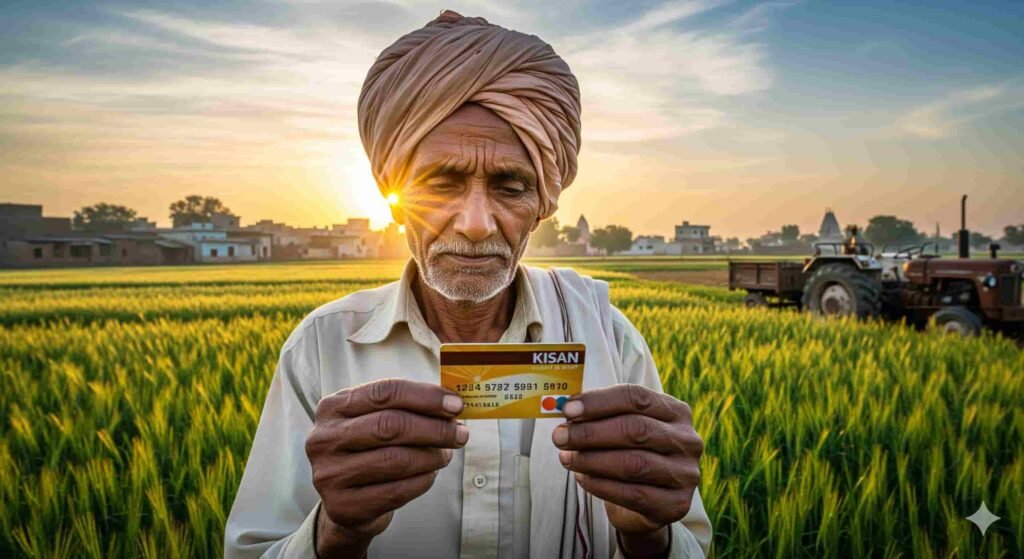
Kisan Credit Card accident insurance is a hidden safety net many farmers overlook. Beyond seasonal credit for seeds and fertilizers, a KCC may also protect your family against sudden accidents—either through a low-cost Personal Accident Insurance Scheme (PAIS) offered by your bank or via the RuPay program linked to your KCC card (which has simple usage rules). This guide explains how the cover works, who’s eligible, typical costs, and the basic claim steps—in clear language you can act on.
Kisan Credit Card vs Accident Insurance
Kisan Credit Card accident insurance is often confused with the card itself. The KCC is a credit tool for farm cash flow; the accident cover is a risk shield that may ride along with it (via bank PAIS or the RuPay program). They work together but are separate benefits.
Kisan Credit Card — what it is
A revolving credit line aligned to the crop cycle so funds can be drawn, repaid after harvest, and redrawn as needed. It serves common farm requirements through one account.
- Pays for inputs, post-harvest needs, minor repairs, and allied activities.
- Operates as an account + card (often RuPay) for branch/ATM/POS/UPI access.
- Typically reviewed annually so limits adjust with acreage, yields, and costs.
Kisan Credit Card accident insurance — what it is
An add-on protection linked to your KCC—either a bank’s Personal Accident Insurance Scheme (PAIS) or the RuPay card program. It complements credit by covering major accident risks.
- Covers accidental death and permanent disability (PPD/PTD vary by policy).
- May require opt-in and/or a recent eligible transaction on the card.
- Generally a very low annual premium; separate from crop insurance.
- Applies to accidents only (not illness or natural death).

Accident cover plans available with KCC
Your Kisan Credit Card can include accident protection through two separate routes. One is a bank-run group policy (PAIS) that you opt into; the other is card-linked cover on RuPay KCC cards. Limits, age caps and conditions vary—confirm at your branch and keep the card active.
1) Bank’s Personal Accident Insurance Scheme (PAIS)
- What it is: A master policy some banks take for KCC borrowers (opt-in).
- Covers: Accidental death and permanent disability (PPD/PTD; as per policy).
- Limits & age: Typical cover ₹50,000–₹10,00,000; age caps often up to ~70 years (varies).
- Cost: Nominal annual premium, often shared between bank and farmer; usually debited from the KCC account.
- Claims: Submit via home branch with standard documents (claim form, certificates, FIR/post-mortem if applicable, nominee proof).
2) RuPay card personal accident insurance
- What it is: Complimentary accident cover tied to many RuPay KCC cards (variant-based).
- Covers: Accidental death and permanent total disability; PPD usually not included.
- Limits: Variant-based sums insured (often up to ₹10,00,000 on higher variants).
- Key condition: A recent eligible transaction (POS/e-commerce/linked UPI) within the specified window is typically required.
- Claims: File through your branch with accident documents plus proof of recent card usage.
KCC’s core purpose—why it’s not “just a loan”
A Kisan Credit Card is a revolving, agriculture-first credit line that moves with your crop cycle. You draw for inputs, repay after harvest, and redraw as needed—without taking a fresh loan every season.
It acts as one window for seeds, fertilizers, post-harvest expenses and small repairs, with access through branch, ATM/POS or UPI on the linked account/card. Limits are reviewed annually to match acreage, costs and yield.
Because KCC operates as an account + card, banks and card programs can attach accident cover (PAIS or RuPay), turning everyday farm credit into a basic shield against accidental death or disability.
KCC vs. Personal Loan: An Insurance and Cost Comparison
A quick side-by-side view of how a Kisan Credit Card compares with a standard personal loan—especially on insurance, costs, and repayment flexibility.
*Availability, limits, and conditions vary by bank/card program.
Unpacking the insurance: what’s actually covered 🛡️
1) Bank’s PAIS (Personal Accident Insurance Scheme)
Some banks run a master policy for their KCC customers. Sums insured commonly range from ₹50,000 up to ₹10,00,000. Premiums are nominal and in many cases shared between the bank and the cardholder.
2) RuPay card program
Many KCC accounts are issued with a RuPay debit/smart card that includes personal accident insurance for accidental death and permanent total disability. Higher card variants usually mean higher limits (often ₹2,00,000 or ₹10,00,000). A recent-usage window typically applies (for example, a small POS/e-commerce/linked UPI transaction within a defined number of days).
Coverage snapshot
*Actual limits depend on the bank policy or card variant for the current year.
Cost & who pays
Premiums are typically very low. In many banks the cost is shared between the bank and the farmer, but pricing and splits can change by policy and year.
Key definitions
- Accidental death (AD): Death caused solely and directly by an accident, within the policy’s time limit.
- Permanent Total Disability (PTD): A serious, lasting disability that prevents any work as defined in the policy.
- Permanent Partial Disability (PPD): A lasting partial loss (e.g., one limb or one eye), paid as a percentage of the sum insured.
Important notes
- Natural death or illness is not covered under personal accident insurance.
- For card-linked cover, usage rules apply—no recent eligible transaction can mean no claim.
- Terms vary by bank, card variant, and policy year. Confirm your current limits, age caps, exclusions, and required documents with your branch.
Who is Eligible? (And Why You Must Check)
For the benefit to be paid, eligibility must exist on the day of the accident. Review these essentials and confirm the exact terms with your branch.
You must be a KCC holder: Coverage applies only to a valid Kisan Credit Card account.
You have to be within the age band: Many banks keep the cover between 18 and 70 years. If you are near or above this range, confirm whether cover still applies.
You have to give consent: The cover is usually optional. Banks generally activate it only after you agree, and then debit a small annual premium from the KCC account.
RuPay usage rule (if card-linked): When the cover is attached to a RuPay KCC card, a recent eligible transaction (POS, e-commerce, or linked UPI) within the specified window—often 30–45 days—may be required.
Important: When the insurance does not pay
- Suicide or self-inflicted injuries.
- Accidents while under the influence of alcohol or drugs.
- Injuries or death during military or police duty.
- Injuries from dangerous sports or criminal acts.
- Death due to disease or natural causes (the cover applies to accidents only).
Required Documents Checklist for a Claim
Use this quick checklist when filing a KCC accident claim. It lists what you’ll need for both Accidental Death and Disability .
The claim process — simple, step-by-step (save this)
Steps differ for Bank PAIS vs RuPay. Follow the common flow below, and apply the notes for your cover type.
Step 1: Intimate immediately (don’t wait)
Who to inform: Your home branch first; also the insurer/TPA if their email/phone appears on the policy or card leaflet.
Share right away: KCC/account number, last four digits of card (if RuPay), date/time and nature of accident, place, and nominee contact.
Why speed matters: Most programs have strict timelines for first intimation.
Step 2: Prepare the documents (your checklist)
Make a neat, numbered file (physical + scanned copies):
- Claim form (ask branch/insurer for the correct format).
- Death certificate (for death) or disability certificate/medical records (for PTD/PPD).
- FIR/accident report, if applicable (road accident, etc.).
- Post-mortem report (for death claims).
- Nominee/legal-heir proof (nomination slip or legal-heir certificate, as applicable).
- Identity & bank proofs (ID of claimant/nominee, cancelled cheque or passbook copy for NEFT).
- KCC/RuPay evidence:
- Bank PAIS: KCC account details/statement.
- RuPay: Card copy and statement showing the recent transaction within the required window.
- Hospital documents (discharge summary, bills, doctor notes) describing the injury/accident.
- Number every page and add a simple index sheet on top.
- Submit through your branch and take an acknowledgement (date, stamp, signature). Keep email receipts for scans.
Step 3: Bank verification → insurer → payout
Branch role: Verifies KCC/card details, checks documents, and forwards the claim to the insurer/TPA under the correct program (PAIS or RuPay).
Insurer review: Assesses eligibility (accident vs illness, coverage in force, RuPay usage rule, age limits, exclusions).
Settlement: On approval, payment is made via NEFT to the registered nominee/beneficiary account.
Tracking: Ask for a claim reference number and next milestone (e.g., medical assessor review, awaiting bank certification). Follow up if there’s no movement after the stated period.
Do
- Intimate immediately and keep copies of everything.
- Ensure the nominee on your KCC is up to date.
- For RuPay, keep the card active with a small eligible transaction in the usage window.
Don’t
- Assume natural death or illness is covered.
- Miss timelines or submit incomplete files—common reasons for delays or denials.
Program rules (sum insured, age caps, documents, timelines, usage windows) can vary by bank, insurer, and card variant. Follow the instructions your branch provides for the current policy year.
Kisan Credit Card accident insurance turns an everyday farm-credit tool into a basic safety net. Depending on your bank’s PAIS and your RuPay card variant (with recent-use rules), you may already have cover for accidental death or disability—often for a very small annual premium.
What matters most is activation and proof: keep your KCC/RuPay card active with a small eligible transaction, opt in to PAIS where available, and keep nominee and documents in order. Do these three things and you greatly reduce the chance of a claim being rejected.
FAQs — Kisan Credit Card Accident Insurance (2025)
1) What is KCC accident insurance?
It’s personal accident cover that can attach to a Kisan Credit Card via a bank’s PAIS policy or a RuPay KCC card program, protecting against accidental death and disability.
2) Is it automatic with every KCC?
No. PAIS usually needs enrolment/consent; RuPay cover depends on your card variant and usage rules. Confirm with your branch.
3) PAIS vs RuPay — what’s the key difference?
PAIS is a paid group policy run by the bank (often very low premium, may include partial disability). RuPay is card-linked, typically complimentary, focused on accidental death and permanent total disability, and requires recent eligible card use.
4) What risks are covered?
Accidental death and permanent disability (PTD; PPD under PAIS as per policy). Illness or natural death is not covered.
5) How much cover and what does it cost?
Typical cover ranges from ₹50,000 to ₹10,00,000. PAIS has a nominal annual premium (sometimes cost-shared). RuPay cover comes with the card but usage rules apply.
6) What is the RuPay “usage rule”?
Most RuPay programs require a recent eligible transaction (POS/e-commerce/linked UPI) within a set window before the accident. Keep a small periodic transaction on record.
7) Who is eligible?
You need a valid KCC, enrolment/consent where required, and to be within the age limits of the program (often up to ~70 years). RuPay cover additionally needs recent card usage.
8) What is not covered?
Natural death/illness, self-inflicted injury, intoxication, criminal acts, hazardous activities, and other exclusions listed in the policy wording.
9) Which documents are needed for a claim?
Claim form, death/disability certificate, medical records (for disability), FIR/post-mortem if applicable, ID and bank proof, nominee proof, and KCC/ruPay usage evidence.
10) How do I file a claim?
Inform the branch immediately, compile documents, submit through the branch (they forward to insurer/TPA), obtain a claim reference, and track until settlement.
About Seva Funds & Important Disclosures
About the Author
Prashant SN
Education: MCom (Master of Commerce)
What I enjoy: Finance calculations and building easy tools for everyday decisions
I started Seva Funds to share clean, fast calculators and no-nonsense explanations for India.
Disclaimer
This article explains how accident cover may attach to a Kisan Credit Card through bank PAIS or RuPay programs. Availability, sums insured, age caps, usage rules (e.g., recent transactions), exclusions, documents, and timelines can change by bank, insurer, card variant, and policy year. Always verify the current terms with your branch or insurer before relying on any benefit.
The content is informational and does not constitute financial, tax, legal, or insurance advice. Examples are illustrative. Personal accident policies cover accidents only and have exclusions. Seva Funds does not sell financial products and is not responsible for actions taken based on this article. Consult your bank/insurer or a qualified professional for guidance specific to your situation.
Related reads from SevaFunds
-
Tax Exemption for Senior Citizens (India)
Understand age-wise limits, Section 80TTB interest relief, and filing tips.
-
Post Office MIS vs Bank Monthly FD Payout
Compare steady-income options, pros/cons, and when each works better.
-
Atal Pension Yojana vs PM-SYM
Eligibility, contribution, pension amounts, and key differences at a glance.

